
Checkout drop-off is not a mystery. Baymard Institute research puts the average documented cart abandonment rate above 70%, and a significant portion of that loss happens not because customers changed their minds, but because the checkout process asked too much of them. Too many pages, too many required fields, too many moments where a distraction wins over a purchase.
A simplified checkout solution for PrestaShop does not fix this by redesigning your product pages or adjusting your pricing. The fix is structural, collapse the steps, reduce the friction, and more customers reach the confirmation screen.
The Real Reason Multi-Step Checkouts Lose Orders
Most default PrestaShop checkouts move customers through several distinct pages: account creation or login, delivery address, shipping method, payment method, and confirmation. Each page transition is a decision point. Each decision point is an exit opportunity.
Many merchants describe customers reaching the shipping step and not coming back, or dropping off the moment account creation appears mandatory. The friction is not one big moment; it is the accumulation of small ones.
Guest checkout availability alone reduces this, but it does not eliminate the core problem. The bigger issue is the architecture itself: sequential steps spread across multiple page loads when a single, well-structured page would serve every purpose at once.
What a PrestaShop Simplified Checkout Addon Actually Changes
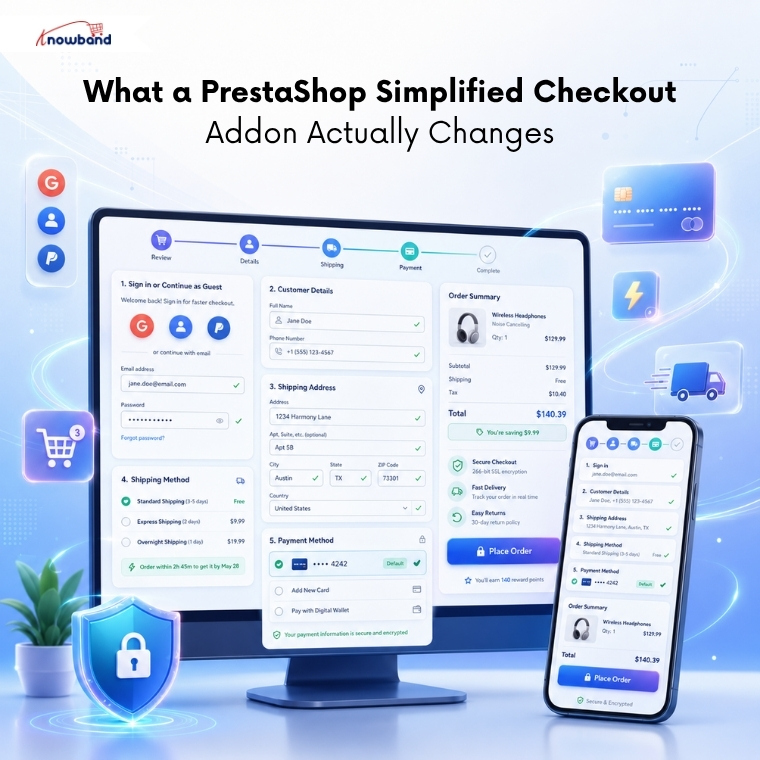
The Knowband PrestaShop One Page Supercheckout consolidates login, address, delivery, and payment into a single page. Customers see the full checkout at once rather than discovering each step after completing the last one. That transparency alone changes how customers interact with the process.
The PrestaShop simplified checkout addon removes page reload time between steps entirely. Inline validation catches field errors in real time. If a postcode is wrong or a required field is empty, the customer sees the correction prompt immediately rather than after a page submission. That single change reduces form-related drop-off without touching anything else.
Social login through Google, Facebook, and PayPal reduces the account creation barrier further. Customers who would abandon at a registration form can complete a purchase in seconds using credentials they already have open in another tab.
The Checkout Behaviour Data That Changes What You Fix
Most merchants know their abandonment rate. Fewer know exactly where in the checkout process customers leave, and fewer still know which fields they skipped or left incomplete before exiting.
The checkout behaviour report inside the PrestaShop simplified checkout addon gives admins a precise graphical breakdown of where customers dropped off and what percentage of each form section they completed. If customers consistently abandon after reaching the payment method block, that is a data signal to act on, not a guess to debate.
The abandoned checkout statistics panel adds a second layer: a comparison of completed order revenue against revenue lost in abandoned carts, filterable by day, week, month, and year. That figure, reviewed weekly, makes the ROI of reducing checkout friction concrete rather than theoretical.
Where PrestaShop One Page Checkout Handles the Edge Cases
A common concern with single-page checkout is compatibility; payment gateways, shipping methods, multilingual stores, and local compliance requirements all add complexity. The PrestaShop One Page Checkout module handles these without requiring workarounds.
The Ship2Pay feature maps specific payment methods to specific delivery options, so customers only see payment methods relevant to the shipping they selected. That removes confusion at the final step, which is exactly where hesitation is most expensive. Stripe Official, PayPal Plus, Amazon Pay, Mollie, and other major gateways are compatible out of the box.
For stores serving European customers, the module is GDPR compliant. Admins can add multiple privacy policy opt-in checkboxes to the checkout page, mark any of them as mandatory, and access a full customer consent log with order reference, timestamp, and accepted consent details. Compliance does not require a separate solution.
The Knowband module also supports multilingual stores, multiple storefronts, and responsive display across mobile and tablet. Country autofill and Google Address Autofill reduce typing effort on mobile, where checkout abandonment rates run higher than desktop across most store categories.
What the Configuration Gives Admins Control Over
The admin panel covers more than the layout. Field visibility and order across the address, delivery, and payment blocks are all configurable without code. Custom fields can be added at any position on the checkout page, useful for gift messages, business registration numbers, or any store-specific data collection need.
The Design tab lets admins adjust column widths and rearrange checkout blocks visually. Custom CSS and JS fields are available for stores that need checkout styling to match a specific theme. None of this requires developer involvement for standard configurations.
Email marketing integrations with Mailchimp, Klaviyo, and SendinBlue mean customer emails captured at checkout can feed directly into post-purchase sequences without manual export steps.
Why Fewer Steps Produce a Measurable Outcome
The argument for reducing checkout steps is not theoretical. It is grounded in how decisions fatigue shoppers and how each additional interaction introduces the possibility of abandonment. When a checkout that previously took four page loads completes in one, the conversion improvement is not a side effect; it is the direct result of removing the barriers between intent and purchase.
For any PrestaShop merchant still running a multi-step default checkout and looking at abandonment data that does not improve, the architecture is the problem. A PrestaShop fast checkout addon is not an incremental tweak; it is the structural change that makes the other optimisations matter.
For more such reads, you can visit:


