
One of the biggest problems in ecommerce is cart abandonment, with Baymard Institute’s analysis of 50 studies putting the average rate at 70.22%. The most common reasons for abandoned carts include product-related questions, shipping, pricing, and ordering. In other words, this is where an AI chatbot for PrestaShop stores is becoming popular, as it provides instant answers to customer queries during critical moments.
But can AI chatbots really improve your conversion rates? Absolutely. AI chatbots can help increase conversions on PrestaShop Stores by reducing friction while shopping, as a chatbot provides answers to customer queries immediately, guiding them to the checkout process. If your chatbot has access to live data about products, inventory, orders, and shipping, it can serve as a valuable aide in the customer journey. In this article, we are going to learn how an AI chatbot for PrestaShop could affect conversions, existing research on the topic, and what functionality store owners should be aware of when looking to buy one.
Do AI Chatbots Increase Conversions on PrestaShop Stores?
There isn’t any comprehensive, peer-reviewed study that measures the impact of “installing an AI chatbot” as one variable and measures its impact on the conversion rate of PrestaShop. This has never been tested at scale, and any number that claims to represent this should be treated with suspicion.
The numbers that exist are those that capture the scale of ecommerce revenue lost due to unresolved friction points, and how fast companies are turning to conversational AI to solve them. The figures were derived from a survey of service leaders rather than from an ecommerce survey. Gartner’s Customer Service and Support practice reported that 54 per cent of organisations were currently leveraging some type of chatbot, virtual customer assistant, or conversational AI platform for customer-facing work. Looking at the global conversational AI market separately, they predicted it will reach $11.58 billion in 2024 and rise above $41 billion by 2030. This is not a conversion lift figure alone, but a testament to the fact that a lot of businesses are staking real money on the assumption that AI-powered customer support works.
Placing those two data points next to the cart abandonment rate, a less sensational conclusion becomes clear: chatbots are not a money-spinner, but they are a solution to a known and costly problem, and their adoption is ramping up because businesses are finding ROI in the process.
What can you expect on a PrestaShop store without one?
Most PrestaShop users are small and medium-scale businesses. Third-party technographic data provider Enlyft reports that roughly a third of businesses operating PrestaShop have fewer than 50 employees, and the majority of these are retail businesses in Europe, with the majority of these being based in France. The problem is that small teams are the least equipped to support them around the clock.
When a customer visits a PrestaShop store and comes asking about size, shipping, or if a coupon can be used with a sale price, they have three options: read through a static FAQ page, wait until morning and perhaps forget about their purchase, or leave. None of those things occurs because there is a defect in the product. The sale was lost as no one was present to reply to a simple query that the customer asked.
A well-configured PrestaShop AI Chatbot is supposed to fill that gap.
Where the Conversion Impact Actually Comes From
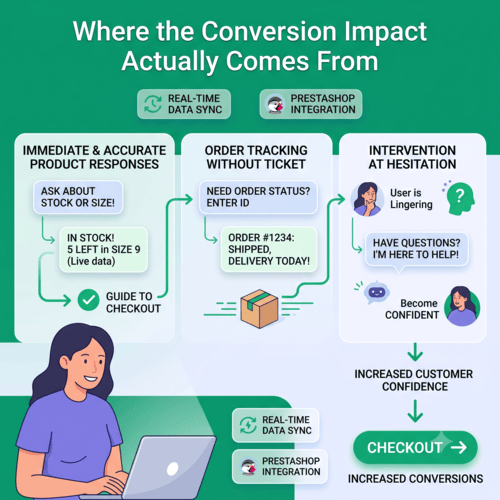
An FAQ with a chat bubble on top of it is not really that different from a chatbot that replies with pre-written responses. The conversion impact, if any, comes from three mechanics.
Immediate and accurate product responses. When a customer asks about stock, size options, or pricing, they get an accurate answer rather than a guess or no response at all. This is only possible if the chatbot is integrated with the store’s real-time product feed, not a fixed training set that goes out of date as soon as products change.
Order and delivery tracking without a support ticket. A large volume of post-purchase contacts is simply “where is my order?” Handling this within a chat window using the customer’s order ID removes a common source of frustration and frees up staff time for queries that genuinely need a human.
Intervention at the point of hesitation. A long time spent on a product page or cart is a positive behavioural signal. A chatbot that offers help proactively at that moment rather than passively waiting for a click is doing something a static page cannot.
None of these mechanics requires a flashy chatbot. They need it to be accurate, fast, and connected to real data, a fairly low bar compared to most marketing copy that comes attached to “AI-powered customer support.”
Where Chatbots Fall Short, and Why That Matters
We do need to be realistic about the limitations. If a bot is unable to identify the intent behind what someone is asking it, it sends that shopper off in the wrong direction and may as well have not had a conversation at all, in which case that interaction would have merely wasted their time. A bot with a shallow knowledge base will confidently say the wrong thing, destroying trust faster than “I don’t know, let me connect you with someone.”
There is also a setup cost that does not get discussed much. Integrating a chatbot with live inventory, multiple languages, and multiple currencies is not a five-minute process. The ones who go this route and launch with a “dummy” bot are the companies that end up saying “chatbots don’t work,” when in reality, theirs just never did. It gets trickier with multi-currency, multilingual stores.
This gets complicated with multilingual, multi-currency stores. A shop selling in French, Spanish and English across three currencies needs a chatbot that recognises the language and currency the visitor is browsing in. One that always responds in the store’s default language will frustrate foreign customers.
The same applies to response speed. Most of the benefit is lost if the chatbot takes several seconds to respond or times out during traffic spikes. When a shopper does not get an answer quickly, they leave, and in their experience, it is as if no bot existed at all.
A Practical Way to Evaluate an AI Chatbot for PrestaShop Store
The market is full of possible AI-powered customer support solutions; however, here is a compiled list of things that you need to check before going with any chatbot :
- Can it retrieve real-time data from the PrestaShop catalogue, or does it need to be updated from a knowledge base and then manually synchronized if there are any product changes in inventory or price?
- Does it detect and respond in all the configured languages/currencies, or only the default?
- Does it provide real-time order information and tracking details, or is it a support form?
- Which underlying model does it leverage, and can this be changed to a different model like ChatGPT, Gemini, or Claude as needed for the type of response?
- Can you see what customers are actually asking, so the setup can be refined over time rather than left on autopilot?
Which brings us to that last point, probably more meaningful than it sounds. This also gives other benefits because, regardless of whether the bot ends up closing a sale or not, a chatbot means that a store owner gets to see what confuses customers before they leave.
Knowband PrestaShop AI Chatbot: How Does It Work?
Besides developing the integration, you can opt for the Knowband PrestaShop AI Chatbot module too. This AI Chatbot for PrestaShop connects to live PrestaShop orders and products, is compatible with multiple languages and currencies, allowing the merchant who purchases this module to select another engine from which they want the AI answer (such as ChatGPT, Gemini, Claude, or DeepSeek), depending on what type of response they would like.
That doesn’t make it a universal fix. If there are any issues with the checkout process or the shipping times, even the best Chatbot will not be able to retain customers. The PrestaShop chatbot for sales does, however, resolve one specific, well-understood problem: questions that are not answered while a customer is in the decision-making process to buy.
The Honest Answer
AI chatbots are not a guaranteed conversion booster. But the evidence states that there are a number of measurable friction points that cause a decrease in sales, where unanswered customer questions play a major role. That is exactly what the AI Chatbot for PrestaShop stores such as Knowband’s is now resolving.
The question is not whether a chatbot for your PrestaShop store will result in a higher conversion rate automatically or not. Does it connect to your store’s live data? Can it process the languages and currencies your customers are using? And does the AI-Powered chatbot enable transparent insight into what they are asking? To experiment with how that applies in practice for PrestaShop, check out Knowband’s PrestaShop AI Chatbot Module.

