
Customers are turning to AI tools for product research, comparison shopping, and decision-making. The real problem for PrestaShop merchants now isn’t understanding that AI matters; it’s preparing their store data so new AI-powered discovery platforms can analyze the catalogue and bring potential customers closer to the store.
AI discovery creates a new implementation gap
AI shopping is moving beyond question answering. ChatGPT can research products, compare options, and provide links to merchants. OpenAI says its shopping systems can use merchant product data, public product information, and other retail sources when building product results.
That creates a new operational question: how should a merchant organize product and store information for AI-mediated discovery? For merchants exploring PrestaShop llms.txt, the answer starts with implementation, not another SEO checklist.
An llms.txt file can provide a curated, machine-readable layer for important store information. It has to be considered as a step towards becoming AI-ready, but not a magic solution that guarantees product recommendations.
Make your catalogue easier to interpret
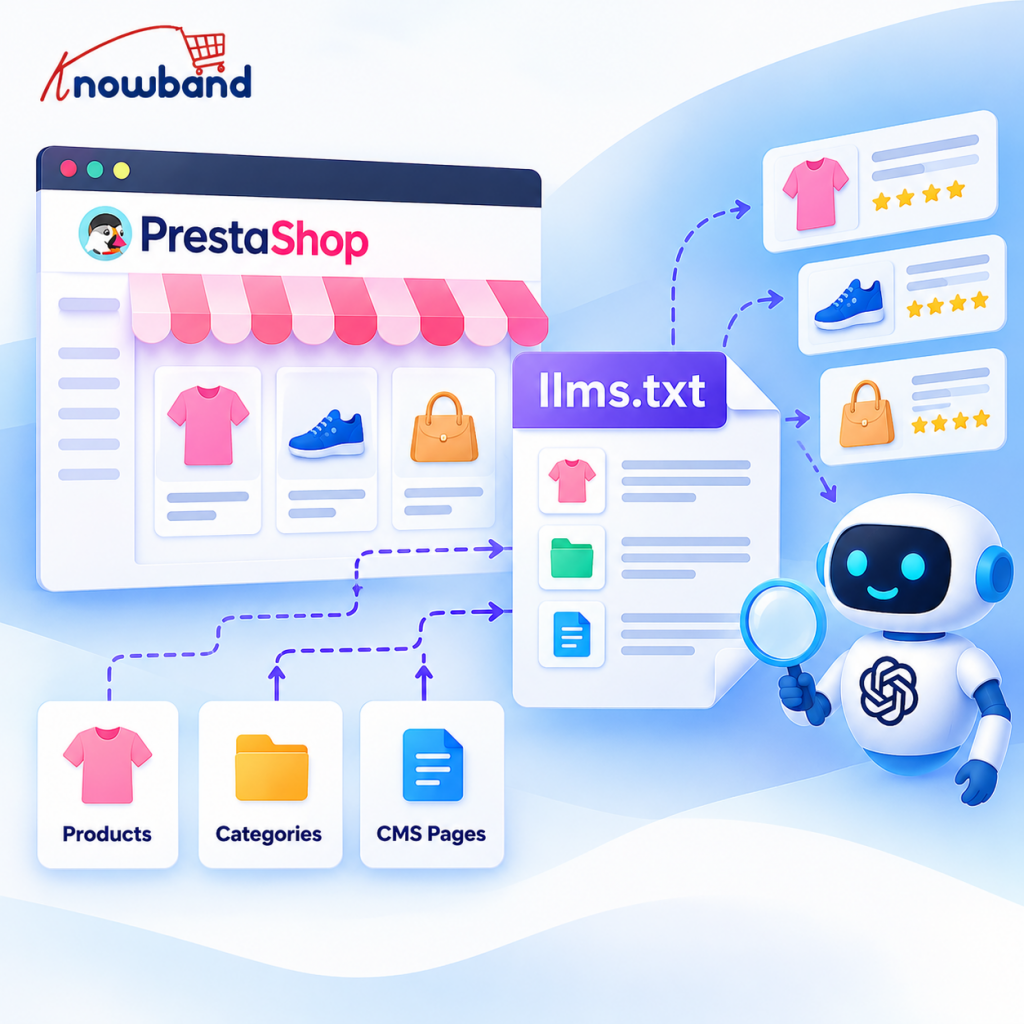
A large catalogue can contain thousands of URLs, variations, categories, descriptions, and supporting pages. Human shoppers can navigate menus and filters, but machine-oriented discovery needs clear context.
A practical PrestaShop llms.txt strategy starts with commercial priorities. Active products, useful categories, and relevant CMS pages may deserve representation, while outdated content may not.
For example, a fashion store could prioritize current collections and their products rather than treating every old catalogue page as equally important. The objective is a cleaner information layer that reflects what the business actually wants discovered.
Keep AI-facing information aligned with the live store
AI readiness isn’t a one-time publishing task. Products appear, disappear, change names, categories, and content throughout the year.
The PrestaShop llms.txt generator module becomes valuable when manual maintenance becomes difficult as a catalogue grows. It can turn that task into a repeatable process by generating information from the store and processing products, categories, and CMS pages in batches.
Knowband’s PrestaShop llms.txt generator uses cron-based batch processing, allowing larger catalogues to be handled in manageable groups. The module supports separate batch settings for products, categories, and CMS pages, with cron executions processing one batch at a time.
The commercial reason is simple: outdated information weakens discovery.
Decide what information should be exposed
More information isn’t always better. A store may contain inactive products, temporary CMS pages, outdated categories, or content that has little value for product discovery.
A PrestaShop addon for llms.txt and AI search visibility becomes useful when the merchant needs control over what enters this information layer. Knowband’s PrestaShop llms.txt module allows administrators to select products, categories, CMS pages, and individual shops for inclusion.
For example, a merchant launching a new collection could prioritize active products and relevant categories while excluding obsolete sections.
The implementation principle is simple: curate the information first, then make it machine-readable.
Give products meaningful context
A collection of URLs doesn’t explain a business by itself. Store descriptions, category relationships, product information, and CMS content can provide additional context about what the merchant sells and how the catalogue is organized.
PrestaShop addon for llms.txt and AI search visibility by Knowband allows merchants to add contextual text around store, category, product, and CMS sections. That helps explain catalogue structure without altering underlying product records.
For example, a skincare store could explain how its categories are organized around different product needs. The objective is clearer catalogue context, not keyword stuffing.
Connect AI visibility with SEO workflow
An AI-facing layer shouldn’t replace SEO. Product pages still need useful descriptions, accurate information, internal linking, and appropriate structured data.
OpenAI’s current shopping documentation shows that product results can use structured information such as product descriptions, price, availability, and product metadata.
A practical workflow is therefore:
- Strengthen product and category content.
- Keep price and availability information accurate.
- Make important pages accessible.
- Curate information for AI-facing discovery.
- Keep the representation updated.
- Track the traffic, engagement, and assisted conversions from those sources whose origin can be detected.
The PrestaShop AI product discovery addon has to be seen in this context as just one of the steps in this process, not as something that replaces SEO and merchants’ product feeds.
Build for scale instead of editing files manually
Multiple shops and large catalogues make maintenance harder. What is manageable on a small catalogue can become a recurring technical task at scale.
The PrestaShop AI product discovery addon by Knowband supports separate shop configurations and batch processing, giving multi-store merchants a more manageable approach to maintaining an AI-facing information layer. The manual confirms that separate llms.txt files can be generated for individual shops in a multi-store setup.
For ecommerce teams, the benefit is fewer repetitive updates and less manual maintenance.
Turn AI visibility into a revenue workflow
An AI-readable file does not generate sales. Revenue comes from what happens after discovery.
A useful measurement path is AI discovery → relevant product exposure → store visit → consideration → conversion.
Merchants can monitor identifiable referral traffic, product engagement, assisted conversions, branded searches, and sales associated with emerging discovery channels.
Knowband’s PrestaShop addon for llms.txt and AI search visibility helps establish the information layer needed for this experimentation. Pricing, availability, content, and conversion experience still determine what happens after discovery.
The important distinction is that the file is infrastructure, not the revenue event. Its commercial value should therefore be evaluated as part of a broader AI-discovery workflow.
How PrestaShop merchants can approach AI discovery
The same question applies across ecommerce platforms: how can catalogue information be represented clearly without another manual maintenance burden?
PrestaShop merchants can use a PrestaShop AI product discovery addon as part of their workflow.
The platform is only the starting point. The objective is a repeatable system built around accurate data, deliberate content selection, context, and updates.
A practical next step for PrestaShop stores
Once your store is already doing the work on SEO, product content, and e-commerce discovery, you need to get organized for an increasing reliance on an AI-based discovery ecosystem.
Knowband’s PrestaShop llms.txt generator module offers an effective means of creating that layer for PrestaShop, collecting products, categories, CMS pages, and other information in the context of your store while allowing administrators to have a say in how that information is represented.
The PrestaShop llms.txt generator module provides merchants with a more formal means of managing this process without manually updating an AI-friendly file.
The bottom line? AI discoverability needs to be seen as an implementation process rather than a file upload exercise. Organize your catalogue, curate what needs to be curated, keep it updated, link it to SEO, and measure whether that discovery translates into qualified traffic and sales.
For more such reads, you can visit:


